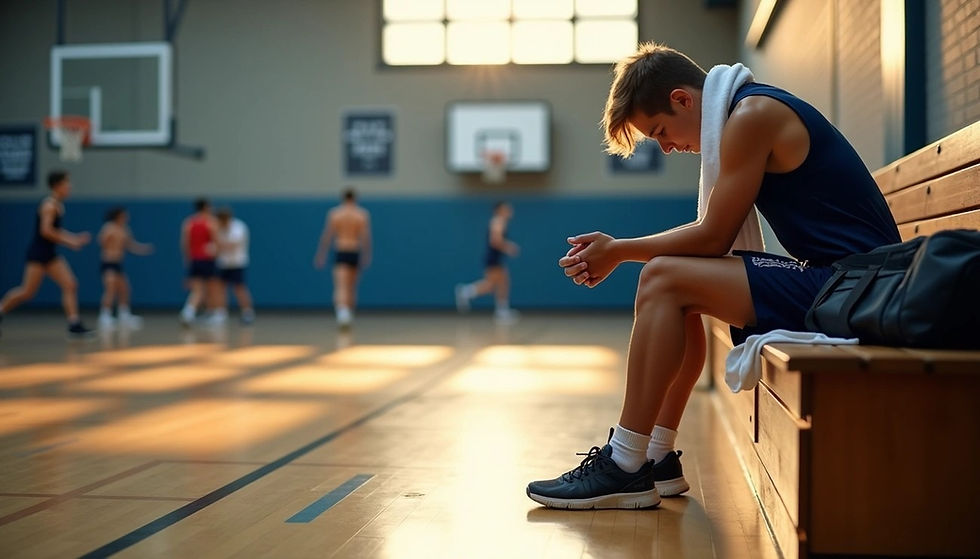
Exposure Therapy in Sport: The Proven Method Athletes Use to Overcome Performance Anxiety
- Dr Paul McCarthy

- May 6
- 10 min read

The plight of collegiate athletes confronting anxiety seems a fitting allegory for our profession's peculiar contradiction. Nearly one in three report symptoms consistent with anxiety disorders [7], yet we persist in sculpting physical prowess while permitting psychological fears to dwell unchallenged in the shadows of performance. I'm drawn to question this curious paradox: why do we meticulously condition sinew and bone whilst fleeing from the very terrors that undermine our athletic endeavours?
In my exchanges with athletes and sport psychologists alike, I often pose this inquiry: what compels us to treat anxiety as an unwelcome tenant to be managed rather than a familiar adversary to be faced? The sense I draw from these conversations suggests we've grown accustomed to avoidance masquerading as sophistication. Traditional exposure-based therapy yields response rates of up to 49% for social anxiety disorder and 44% for PTSD [7], figures that speak to both promise and limitation within our current understanding.
Exposure therapy in sport emerges not as revolutionary panacea but as forgotten wisdom - the acknowledgment that confrontation often proves more efficacious than circumvention. Perhaps it is not an intentional choice but we seem drawn toward managing symptoms rather than approaching the situations that birth them. The reflection about facing fears directly, the texture of athletic courage under duress, appears excluded or sequestered in many contemporary approaches to performance anxiety.
These pages explore what exposure therapy signifies for those who compete, how such approaches differ from conventional mental training, and the practical architecture for implementing exposure within sporting contexts. Yet these are not prescriptive diktats; they serve as guide ropes for one's journey through the labyrinth of performance anxiety, where each athlete must ultimately open their own doors to confront what lies within.
The Architecture of Avoidance: What Sport Psychology Typically Offers Athletes
The Familiar Cartography of Anxiety Management
Athletes traverse territories of scrutiny from teammates, coaches, and spectators, where the consequences of failed performance range from personal mortification to the stark reality of lost contracts and diminished livelihood [7]. Our profession's customary response maps this terrain through cognitive reframing, relaxation protocols, mindfulness practices, and sundry coping strategies designed to diminish anxiety's symptoms [7]. These approaches target the anxiety itself—progressive muscle relaxation, positive self-discourse, breathing modulations, and narrative reconstruction [7].
I
debate which assumes priority here: Do we address the anxiety or the situations that birth it? Perhaps our tendency toward symptom management reflects something more fundamental about how we conceptualize distress in athletic performance.
The Internal Furniture of Different Approaches
Exposure therapy operates from premises that challenge conventional mental training paradigms. Rather than managing anxiety's manifestations, exposure-based work transforms behavior by approaching anxiety-provoking circumstances rather than circumventing them [7]. Avoidance patterns—whether declining game-winning shots or delaying return from injury—reinforce anxiety through a predictable concatenation of events where fear strengthens with each retreat [3].
This distinction matters more than mere therapeutic preference. Traditional methods encourage athletes to think differently about stress; exposure therapy requires athletes to act differently within stressful milieus. The reflection about direct confrontation versus sophisticated avoidance seems excluded or sequestered in many contemporary discussions of athletic mental preparation.
The Neuroscience Beneath Our Professional Practice
Exposure therapy demonstrates efficacy for anxiety disorders through clinically meaningful advantages over psychological placebo conditions [4]. Fear extinction emerges through repeated exposure to feared stimuli without negative consequences, creating new learning that supplants previous associations [4]. The neuroanatomical substrate involves the amygdala (implicated in fear conditioning), ventromedial prefrontal cortex (which suppresses amygdaloid activity), and hippocampus (necessary for extinction learning consolidation) [4].
Yet I'm drawn to question: does understanding these mechanisms change how we implement such approaches, or do we sometimes let scientific sophistication obscure the fundamental simplicity of facing what we fear? Gradual exposure to performance situations desensitizes nervous system responses to anxiety triggers [1], whilst inhibitory retrieval-based exposure assists athletes in managing debilitative anxiety and focusing on optimal performance methods [5].
Those Who Journey Through Exposure's Territories
Athletes experiencing avoidance patterns benefit most from exposure to scenarios that trigger anxiety within sporting contexts. Sport psychologists employ exposure techniques to help athletes confront fears through gradual, supported progression—role-playing stressful scenarios or methodically reintroducing pressure within training environments to reconstruct confidence [3].
The loose threads of individual fear patterns, when acknowledged and addressed directly, strengthen the cement that holds athletic performance together. These interventions are not prescriptive formulas; they serve as travellers' guides for those willing to map their own territories of anxiety and courage.
The Architecture of Fear: How Exposure Dismantles Performance Anxiety
The Curious Alchemy of Avoidance
Avoidance operates through a peculiar alchemy that transforms momentary relief into enduring bondage. The mechanism appears deceptively simple: athletes experience immediate succour when eschewing feared situations, which instructs the nervous system that retreat functions efficaciously. Each repetition strengthens this foundation until the edifice of avoidance becomes the athlete's primary dwelling. Those who sidestep game-winning shots or postpone returns after injury unwittingly architect their own diminished territories.
Fear avoidance after musculoskeletal injury reveals itself through activity restriction born of pain anticipation, contributing to persistent symptoms, depression, and disability. Athletes exhibiting higher fear avoidance report amplified post-concussion symptoms, whilst those harbouring injury-related trepidation face thirteen-fold increased risk of secondary ACL injury within twenty-four months of medical clearance. The paradox emerges stark: protection becomes peril.
Dismantling Fear's Architecture Through Controlled Confrontation
Exposure therapy operates through four distinct yet intertwoven mechanisms that challenge fear's supremacy. Habituation describes the gradual diminishment of reactions when repeatedly encountering feared circumstances. Extinction weakens previously forged associations between dreaded activities and catastrophic outcomes. Self-efficacy emerges as athletes discover their capacity to face terrors and regulate distress. Emotional processing permits the attachment of novel, realistic appraisals to formerly overwhelming situations.
The habituation model stipulates that exposure furnishes structured communion with feared stimuli whilst minimising opportunities for avoidance, escape, or compensatory behaviours. Anxiety reduction materialises through sustained contact with the feared stimulus absent these defensive manoeuvres. Here lies the crux: presence rather than absence becomes the therapeutic agent.
The Tripartite Methods of Confronting Fear
Sport psychologists employ three primary approaches to orchestrate this confrontation. In vivo exposure demands direct, corporeal engagement with feared objects or circumstances. Imaginal exposure harnesses vivid mental imagery to recreate dreaded scenarios within controlled contexts. Interoceptive exposure deliberately reproduces physical sensations that, whilst harmless, provoke significant apprehension.
The pacing of such interventions varies considerably. Graded exposure constructs hierarchical progressions from moderately challenging tasks toward increasingly demanding ones. Flooding commences with the most formidable challenges immediately. Systematic desensitisation marries exposure with relaxation techniques, creating hybrid approaches that acknowledge individual tolerance.
The Corporeal Poetry of Anxiety
Somatic anxiety manifests through the body's vernacular: laboured breathing, cardiac acceleration, perspiration. Cognitive anxiety speaks through distressing cognitions that compromise performance and attention. Interoceptive exposure addresses athletes' tendency to catastrophise and fear these anxiety-related bodily sensations, mistaking normal physiological responses for harbingers of disaster.
Vigorous physical activity generates physiological responses remarkably similar to anxious states, yet within contexts associated with health benefits rather than peril. The repeated pairing of intense physiological arousal with safe, controllable environments promotes fresh learning about bodily sensations as benign rather than threatening. The body's language, once interpreted as alarm, becomes recognised as merely conversation.
The Architecture of Confrontation: Constructing Pathways Through Fear
First Quarter: Mapping the Terrain of Athletic Avoidance
I often observe athletes retreating into familiar chambers when anxiety knocks at their door. Behavioral analysis begins with recognizing these moments - the hesitation before crucial tasks, the subtle avoidance of movements that once felt natural, the distress that signals retreat rather than approach [6]. The Athletic Fear Avoidance Questionnaire offers a structured reconnaissance through 10 items scored on a 5-point scale, yielding total scores from 10 to 50 points [7]. Higher scores illuminate greater fear avoidance patterns [7], yet I find myself questioning whether we adequately explore the texture of these retreats - the stray thoughts and feelings that accompany such moments of withdrawal.
Second Quarter: Erecting the Hierarchy of Feared Territories
The construction of an exposure hierarchy resembles the careful planning of a journey through increasingly challenging terrain. One develops a cartography of feared situations using the Subjective Units of Discomfort Scale [6], ranging from 0 (tranquil waters) to 100 (tempestuous seas) to communicate the distress each exposure might provoke [6]. The hierarchy should encompass approximately 10 to 15 waypoints [2], though most practitioners counsel against including territories rated below 20 or 30 [2]. In my exchanges with athletes, I sense an unspoken preference for avoiding this systematic cataloguing of fears - perhaps because it forces acknowledgment of what we'd rather leave unexamined.
Third Quarter: Stepping Through Doors of Graduated Difficulty
The initial foray begins with exercises rated around 30 on the scale [2] - challenging yet navigable passages for the athletic psyche [2]. Athletes must remain within these exposures until anxiety diminishes by half its peak intensity [2], a process requiring patience with discomfort rather than flight from it. The curious phenomenon emerges where successful habituation to easier exercises shifts the landscape entirely, altering how athletes perceive the remaining hierarchy [2]. This mirrors the way opening one door in a residence changes one's relationship to all other unopened doors.
Fourth Quarter: Befriending the Body's Symphony of Distress
Interoceptive exposure invites athletes to reconsider their relationship with bodily sensations previously deemed threatening [6]. Simple exercises - breath holding, spinning, vigorous movement, controlled hyperventilation [6] - recreate the physical vocabulary of anxiety within controlled circumstances [6]. These practices seem to ask: what if the pounding heart and shortened breath are not harbingers of catastrophe but merely the body's honest communication? The reflection about befriending rather than fearing these sensations appears excluded from many traditional approaches to athletic mental training.
Fifth Quarter: The Repetition That Builds New Furniture for the Mind
Athletes require repeated encounters with feared emotions to construct new experiences of safety [7]. I encourage the maintenance of an Exposure Tracking Log - a written testimony to exercise content, duration, and the evolution of subjective distress ratings [2]. This documentation serves not as mere record-keeping but as evidence of the mind's capacity to relearn its responses to previously overwhelming situations.
Sixth Quarter: The Ongoing Journey Beyond Initial Conquest
The development of a relapse management framework acknowledges that growth rarely follows linear progression [6]. Booster sessions, typically scheduled after two months, serve as checkpoints on this continuing journey [6]. These are not admissions of failure but recognition that the internal furniture of an athlete's mind requires occasional rearrangement, that the maps we create for confronting fear need periodic updating as new territories emerge and familiar ones shift their contours.
Witnesses to Transformation: What Athletes Reveal About Fear's Territory
The Testimony of Those Who Have Journeyed
A seventeen-year-old elite cross-country skier's plight mirrors countless others who discover that finishing last births more than temporary disappointment [6]. Her extreme nervousness before races and anxiety about uphill segments created a familiar pattern of escalating avoidance. Yet exposure therapy intervention yielded what many would consider modest gains: five repetitions during interval sessions with anxiety lowered to 30 on the 0-100 scale [6]. She perceived lower anxiety levels, less avoidant behaviors, and more functional sport-specific behaviors [6]. The texture of her experience suggests that progress often appears unremarkable to external observers whilst feeling monumental to those who inhabit it.
Graham DeLaet's seven-year tenure on the PGA Tour dissolved into paralyzing fear standing over chip shots, compelling his withdrawal from the 2016 Memorial Tournament [8]. His subsequent work with a sport psychologist yielded steady improvement [8], though I wonder what conversations occurred about the unpalatable motivations that might have contributed to his initial success and later struggles.
The Internal Furniture Athletes Rearrange
Athletes who seek professional treatment for phobias generally witness improvement, with results enduring when they continue employing learned techniques [9]. Michael Phelps struggled with anxiety during his swimming career yet worked with professionals to address it [10]. Simone Biles openly shared her journey through performance anxiety to Olympic championship [10]. However palatable or unpalatable their reasons for seeking help might have been, these athletes demonstrate how acknowledgment of difficulty strengthens rather than weakens competitive resolve.
The sense I draw from such testimonies suggests athletes often discover their true motives for competing only after confronting what they most wish to avoid. Perhaps the anxiety itself serves as an unwitting guide toward authentic engagement with sport.
When Professional Guidance Becomes Necessary
Professional assistance assumes priority when anxiety infiltrates sleep, appetite, relationships, or daily functioning [3]. Regular anxiety episodes during seasons or specific competitions warrant consultation with licensed mental health professionals [11]. Yet I debate whether we adequately prepare athletes to recognize these thresholds before crisis demands intervention.
The Mesh of Complementary Approaches
Exposure therapy weaves effectively alongside imagery practice, which enhances athletic performance across agility, muscle strength, tennis and soccer domains [12]. Process-oriented goal setting complements exposure work with particular efficacy [13]. The loose threads of varied therapeutic approaches, when properly integrated, strengthen the cement that holds athletic development together rather than competing for singular prominence.
The Internal Furniture of Fear: A Reflection
The loose threads within exposure therapy's architecture strengthen the cement that holds athletic performance together, though perhaps not in ways we initially anticipated. Fear extinction operates through mechanisms both elegant and paradoxical - the very act of approaching what we flee creates new learning that supersedes old certainties. Yet the sense I draw from this exploration suggests that confrontation alone proves insufficient; athletes must inhabit their fears long enough to discover them transformed.
However palatable or unpalatable our motives for avoiding difficult emotions might be, I feel the carapace of how we are 'supposed' to manage anxiety limits our effectiveness because we deny the existence of the very experiences that strengthen us. The reflection about fear's texture, the stray thoughts that accompany terror before crucial performances, the moments when courage falters - these elements seem too often excluded from our professional discourse about athletic excellence.
Athletes who commit to gradual, repeated practice within feared territories discover what elite performers have always intuited: avoidance feeds the beast whilst confrontation starves it. The science of fear extinction merely confirms what the internal furniture of an athlete's mind already whispers - that true mental resilience emerges not from the absence of fear but from one's willingness to dwell alongside it until familiarity breeds contempt rather than terror.
These pages are not prescriptive formulas; they are travellers' guides for those willing to open doors previously kept bolted shut, to sit with discomfort until it becomes merely sensation rather than threat. The hierarchy of fears, when approached with systematic patience, reveals itself to be less mountain than molehill - though the climbing remains no less essential for that diminishment.
Key Takeaways on Exposure Therapy in Sport
Exposure therapy offers athletes a proven alternative to traditional anxiety management by confronting fears rather than avoiding them, leading to lasting performance improvements through systematic practice.
• Face fears, don't manage them: Unlike relaxation techniques, exposure therapy requires athletes to approach anxiety-provoking situations rather than avoid them, breaking the cycle that strengthens fear.
• Build a systematic exposure hierarchy: Create a 10-15 item list of feared situations rated 0-100 on anxiety scale, starting with moderate challenges (30 rating) and progressing gradually.
• Practice interoceptive exposure: Deliberately recreate physical anxiety symptoms through exercises like breath-holding or spinning to learn these sensations are harmless, not dangerous.
• Commit to repeated exposure: Continue each exercise until anxiety decreases by at least half the peak level, with multiple repetitions needed to create lasting fear extinction.
• Seek professional help when needed: If anxiety interferes with sleep, relationships, or daily functioning, or occurs regularly during competitions, consult a licensed mental health professional.
The key to success lies in systematic, gradual confrontation of feared situations rather than avoidance. When combined with proper tracking and professional guidance when necessary, exposure therapy transforms anxiety from a performance barrier into manageable sensations that no longer control athletic behavior.
References
[1] - https://www.sunrisecounselingdallas.com/blog/anxiety-management-in-sports-colorado[2] - https://pmc.ncbi.nlm.nih.gov/articles/PMC4464974/[3] - https://pmc.ncbi.nlm.nih.gov/articles/PMC8508314/[4] - https://ocdandanxietycenterofcleveland.com/anxietyblog/2018/9/24/whats-the-difference-between-cognitive-behavioral-therapy-and-exposure-with-response-prevention-and-exposure-therapy[5] - https://www.healthintandem.com/blog/therapy-for-performance-anxiety[6] - https://www.tandfonline.com/doi/abs/10.1080/10413200.2023.2166154[7] - https://researchonline.ljmu.ac.uk/4777/3/Cognitive Behavioral Intervention in Sport Psychology A Case Illustration of the Exposure Method with an Elite Athlete.pdf[8] - https://www.drpaulmccarthy.com/post/building-cbt-formulations-for-psychological-skills-training-in-elite-athletes[9] - https://www.therapistaid.com/therapy-guide/creating-an-exposure-hierarchy-guide[10] - https://www.peaksports.com/sports-psychology-blog/performance-anxiety-in-sports/[11] - https://drstankovich.com/help-for-athletes-struggling-with-sport-phobias/[12] - https://drmichellecleere.com/blog/the-role-of-sports-psychology-in-overcoming-performance-anxiety/[13] - https://www.hopkinsmedicine.org/health/wellness-and-prevention/5-tips-for-overcoming-sports-performance-anxiety-in-student-athletes[14] - https://pmc.ncbi.nlm.nih.gov/articles/PMC12109254/[15] - https://bellairefamilycounseling.com/interview-with-jacob-weissman-about-ocd-perfectionism-and-sports/