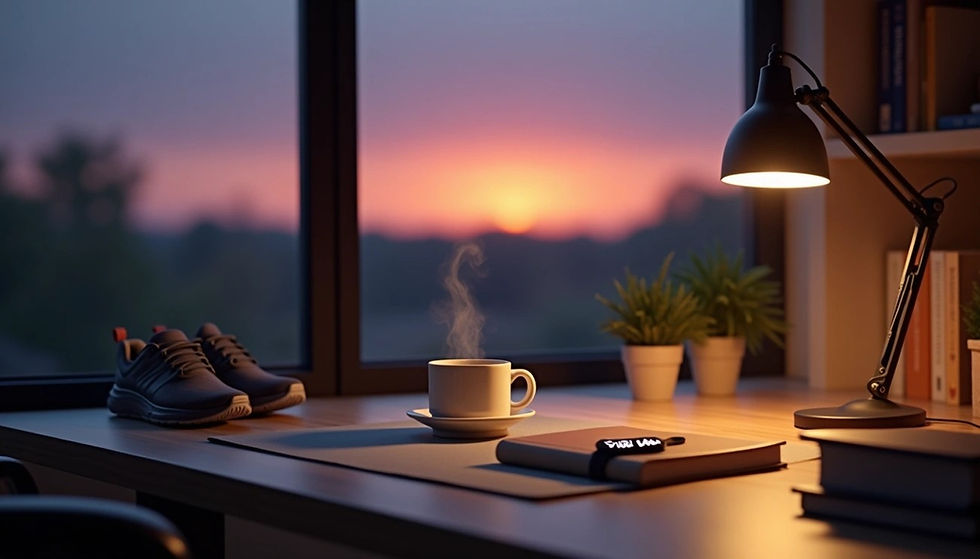
Why Your Room Layout Could Be Sabotaging Your Habits (Science-Backed Truth)
- Dr Paul McCarthy

- Jan 12
- 11 min read

Willpower alone doesn't shape your habits - your environment does . People often struggle to build positive habits and find themselves reverting to old patterns without knowing why.
Our surroundings quietly shape our daily behaviors in powerful ways . A room's layout is a vital part of forming lasting habits. Without thoughtful design of our spaces, environments will mold our habits automatically - usually not the way we want . This reality explains why many people find habit-building difficult. The challenge goes beyond personal discipline.
This piece explores how your physical space shapes behavior patterns and why the right environment helps create successful habits. You'll discover practical ways to design spaces that support your goals instead of working against them. Smart environmental design can help build an atmosphere that reinforces good habits and naturally discourages bad ones -sabotaging y our habits.
How your room layout influences your daily behavior
Your living space's architectural design does more than catch your eye—it rewires your brain and shapes your behavior. Room layouts create powerful environmental cues that spark automatic responses. These responses often bypass your conscious thoughts.
The science of environmental cues
Your brain constantly picks up signals from every space you occupy. Research reveals that room geometry directly affects your mood, energy levels, and thinking abilities [1]. To cite an instance, rectangular rooms tend to bring out negative emotions. Rooms with curved designs boost positive feelings and help you relax [1].
These effects go beyond just emotions. Curved spaces spark creativity, which makes them ideal for work and learning spaces [1]. The acoustics and lighting in a room also affect how comfortable you feel. Noisy spaces or rooms with harsh lighting can make you anxious and irritable [2].
Your reactions aren't just about what looks good. They show how your brain processes space at its core. The basal ganglia—especially the striatum—connects what you see and feel with automatic actions [3]. Your brain builds strong neural pathways when you see certain room layouts over and over. These pathways trigger behaviors without you even thinking about them.
Dopamine, a crucial brain chemical, strengthens these connections. Scientists have found that "dopamine neurons are one way our brains give the cues around us meaning" [4]. These neurons can make environmental signals motivating, which programs you to react to your surroundings in specific ways.
Why surroundings matter more than willpower
In stark comparison to this common belief, lasting habits depend more on your environment's design than motivation. James Clear points out, "We often overestimate the power of motivation and underestimate the influence of our environment" [3]. Your habits become easier to build when your surroundings match your goals.
Your brain keeps making connections between what you do and where you do it. These connections, once they're firm, trigger automatic responses that "persist even after conscious motivation or interest dissipates" [5]. This explains why willpower often fails—it's up against deep-rooted neural pathways.
Context's power becomes crystal clear during environmental shifts. Students who changed universities kept their routines only when their performance triggers stayed the same [6]. Their habits changed when these triggers shifted, whatever their intentions were.
Small tweaks to your environment can change behavior dramatically. PetSmart raised $31.77 million by adding a donation prompt to their checkout process [7]. People eat 22% less food just by switching from 12-inch to 10-inch dinner plates [7].
These findings tell us something important: your habits rarely succeed based on personal traits alone. The right environmental cues—and removing unhelpful ones—create the foundation for lasting change. Your room layout either helps or hurts your desired habits, whatever your determination level might be.
Common room layout mistakes that sabotage habits
Your room's layout might secretly work against your plans to build good habits. Even with strong motivation, some setups actively fight against your goals. Learning about these common mistakes helps you create spaces that support rather than hurt your efforts.
Cluttered spaces increase stress and reduce focus
A messy environment does more than look bad—it drains your brain. Research shows that clutter fights for your attention. Your brain must constantly choose what to ignore and what to focus on. So fewer mental resources remain available for tasks you want to concentrate on [8].
Women who live in cluttered homes show much higher levels of cortisol (the stress hormone) throughout the day [9]. This physical reaction explains why messy spaces drain us mentally—our bodies stay in a mild stress response.
Clutter creates a chain of negative effects:
Starting with low mental energy makes developing habits extra tough because clutter drains your resources first.
Lack of visual cues for good habits
Our brains react strongly to what we see. Habit formation becomes harder without proper visual prompts in your space. Behavioral scientists point out that "To bring out a response, we must be exposed to a cue; our behaviors are largely shaped by what we can see in front of us" [11].
Visual reminders boost the chances you'll do habits you want to build [11]. Many room layouts hide these vital habit triggers.
People with ADHD or attention issues face bigger challenges. Habit sequences often disappear when visual cues move around, vanish from sight, or get buried under stuff—even when someone wants to keep doing the action [12].
Easy access to distractions
Things closest to us get used most often. Many room layouts put distractions right where we can see them while tools that support good habits end up in closets or drawers.
Environmental triggers can knock you off track [13]. To cite an instance, see how eating healthy becomes harder when your kitchen contains tempting junk food [13].
We tend to choose the easiest option. If your phone sits on your nightstand while exercise equipment hides in a closet, you know which behavior wins most times.
No defined zones for specific activities
Your brain doesn't connect spaces with specific behaviors without clear boundaries between activity areas. Research about activity zoning shows spaces should be divided by their purpose to create better layouts [14].
Most homes lack proper zones, which leads to several issues:
Your brain can't form strong links between places and behaviors without designated areas for specific routines. This makes habit cues weaker.
Mixed-use spaces confuse your mind. Trying to work where you watch TV sends unclear signals about appropriate behaviors.
Spaces without clear purposes let activities mix together, which creates distractions and reduces productivity. Working from bed blurs mental lines and hurts both work focus and sleep quality [15].
The answer lies in creating distinct activity zones with smart design that uses the right lighting, sound control, and materials to separate different areas [16]. Strategic zoning builds environmental triggers that naturally guide you toward habits you want to form.
How to design your space to support habit building
Successful habit formation depends on designing your environment with purpose. A thoughtful arrangement of your space makes good behaviors feel natural and unwanted actions harder to do.
Make good habits visible and available
Your daily actions respond directly to visual cues around you. Research from Cornell's Food and Brand Lab shows that visible healthy food led to 48% more consumption [17]. This principle works for any habits you want to develop.
You can use this effect by:
Keeping your water bottle on your desk as a reminder
Putting fruits and vegetables at eye level in your fridge
Setting out workout clothes before bed
Placing your current book on your pillow instead of a bookshelf
Three core ideas shape environment design: good habits should be easy, bad habits should be hard, and consistency matters [18]. Visual placement of habit-related items removes decision points and eliminates mental friction.
Create friction for bad habits
Making unwanted behaviors harder works as effectively as making good habits easier. Research shows that a mere 10-second delay in social media access cut usage by 22% without any other changes [4].
Smart placement significantly changes consumption patterns. Hidden junk food led to 23% less intake [4]. These principles work when you:
Put unhealthy snacks in opaque containers on high shelves
Unplug the TV after each use
Sign out of social media after browsing
Keep your phone in another room during work
Use lighting and layout to guide behavior
Your space's lighting shapes your mood and behavior. Cool, blue-toned lighting boosts alertness and focus, while warm, yellow-toned lighting encourages comfort and relaxation [19].
Different areas need appropriate lighting. Bright, cool lighting suits productivity zones best, while warm lighting works better in relaxation spaces. This difference helps your brain recognize activity zones and builds habit associations.
Designate zones for specific routines
Dedicated activity spaces rank among the most effective environmental design strategies. These zones simplify behavior change by offering consistent cues and reducing decision fatigue.
Thoughtful arrangement creates distinct areas even in small spaces. A cozy reading nook needs proper lighting and a comfortable chair. A specific corner works for meditation or exercise, regardless of size [18]. Your brain soon connects these spaces with their intended activities.
James Clear says, "Be the designer of your world, and not merely the consumer of it" [20]. Smart environment design programs your surroundings to guide you toward better choices automatically—without relying on willpower alone.
Tools and tricks to reinforce new habits at home
Tools and techniques can boost your habit-building efforts beyond simple space organization. These practical approaches create triggers that lead to consistent action.
Use habit trackers and visual reminders
Visual tracking shows you right away how far you've come, which makes forming habits more effective. Research shows people who track their habits are twice as likely to achieve goals like weight loss compared to those who don't [21]. The quickest way is to mark days on a calendar when you complete your habit. This creates a visual chain you won't want to break.
Digital habit trackers are a great way to get extra benefits through statistics that show streaks, completion rates, and progress patterns. These apps work best when they need minimal effort—tracking should take seconds to avoid becoming a burden [22].
Visual reminders work best where you naturally see them. Sticky notes on bathroom mirrors, phone wallpapers, or strategically placed objects serve as powerful cues. These reminders need to be striking enough to catch your attention despite other visual distractions [12].
Use color, scent, and sound as cues
Sensory triggers bypass your conscious mind and create strong habit associations. Scent works differently from other sensory inputs—smells travel straight to your brain's limbic system and connect with memory and emotion [23].
This physiological pathway makes scent especially effective when you want to form habits. A specific cologne during work or a unique fragrance before exercise can help. Soon, these scents alone will trigger the behavior you want [23].
Anchor new habits to existing routines
Habit stacking connects new behaviors to old ones using this formula: "After I [current habit], I will [new habit]" [3]. This approach utilizes neural pathways already built in your brain.
Pick anchor habits that happen each day without fail—like brushing teeth or making coffee—then add your new behavior right after [7]. Morning and evening routines are the most reliable anchors for habit stacking [6].
Keep essentials within reach
Strategic object placement creates natural cues for behaviors you want. Your workout clothes should be by your bed, water bottles next to coffee makers, and books on pillows [24].
Removing temptations from sight matters just as much. Keep unhealthy snacks in basements, phones outside bedrooms, and distracting items in drawers [24]. This works because your environment guides your actions naturally without conscious effort.
Adapting your environment as your habits evolve
Habits evolve naturally over time, and your environment needs to keep up with these changes. Life stages bring new needs, so your space must adapt to support your routines and growing aspirations.
When to change your setup
Your living environment must grow with your changing circumstances. People often stick with layouts that worked at first but now hold them back. The best time to reassess your space comes with major life changes—a new job, relationship changes, or fresh health goals.
The "yo-yo house" concept shows this adaptability well. These properties grow with families because walls can move and spaces serve multiple purposes as needs change [25]. This lets you "rightsize" your environment without moving to a new place.
Signs your layout is no longer helping
These signs indicate your current arrangement might work against you:
You navigate around furniture as if playing "a high-stakes game of Tetris" [26]
Your home has unused corners or "wasted space" [26]
Your stress levels rise and maintaining routines becomes harder
Storage solutions complicate finding items instead of making it easier [26]
Something feels "off" in your space even though you follow your planned habits
Furniture pushed against walls creates problems. The center feels "empty and cold" and conversations become difficult [27].
How to experiment and iterate
Notice how different areas of your environment affect you throughout the day. Look for spaces that energize you and those that create unnecessary stress [1]. Small changes often make the most important improvements. Try moving one piece of furniture or add a strategic storage solution before you redo entire rooms.
A flexible mindset and design help you adapt better. You can try movable partitions, multipurpose furniture, and modular storage that you can easily reconfigure [2]. Your environment becomes a dynamic support system for your habits through thoughtful changes, not just a static backdrop.
Conclusion
Room layouts shape habits more than you might think. Your brain's behavior patterns respond directly to environmental design at a neurological level. Cluttered spaces drain mental resources and increase stress, while rooms without proper organization and visual cues make forming habits harder than necessary.
our environment can be your strongest ally in changing behavior, not just willpower alone. Simple changes bring impressive results without much effort - keep tools for good habits visible, add friction to unwanted behaviors, and set up dedicated zones for activities.
Context plays a crucial role, as science shows. Our brains build strong neural pathways that link specific environments to automatic behaviors. This programming makes us respond to our surroundings without thinking.
On top of that, it's worth noting that effective spaces must grow with your needs. Look for signs that your current layout isn't working anymore and try new strategic adjustments. The goal isn't to create a picture-perfect room - it's to design a space that naturally guides you toward better habits.
Building habits needs personal commitment, but the right environment makes staying consistent almost effortless. Your surroundings either help or hinder you - you decide which. This week, take a close look at your space and find at least one simple change to support your most important habits better. This smart approach to environmental design could be what's missing from your habit-building strategy.
Key Takeaways
Your physical environment shapes your habits more powerfully than willpower alone, making strategic room design essential for lasting behavior change.
• Environmental cues trigger automatic behaviors - Your brain forms neural pathways linking specific spaces to actions, bypassing conscious decision-making entirely.
• Make good habits visible and accessible - Place habit-supporting items where you can see them; studies show visible healthy foods increase consumption by 48%.
• Create friction for unwanted behaviors - Hide distractions and add barriers; even a 10-second delay to social media access reduces usage by 22%.
• Design dedicated activity zones - Establish specific areas for different routines to strengthen habit associations and reduce decision fatigue.
• Declutter to reduce cognitive load - Messy spaces increase cortisol levels and compete for attention, leaving fewer mental resources for habit formation.
• Adapt your space as habits evolve - Regularly reassess and adjust your environment during life transitions to maintain optimal habit support.
The key insight: Stop fighting your environment and start designing it. Small strategic changes to your room layout can make positive habits feel effortless while naturally discouraging behaviors you want to eliminate.
References
[1] - https://www.bridgecounseling.net/blog/2024/11/15/designing-your-environment-for-success-setting-yourself-up-to-adopt-new-habits[2] - https://www.milindpai.com/redesigning-for-life-stages-how-to-make-your-space-adapt-as-you-grow[3] - https://jamesclear.com/habit-stacking[4] - https://www.cohorty.app/blog/friction-design-make-good-habits-easier-bad-habits-harder[5] - https://pmc.ncbi.nlm.nih.gov/articles/PMC3505409/[6] - https://www.calm.com/blog/habit-stacking[7] - https://www.christinecarter.com/2020/12/anchoring-new-habits-to-old-ones/[8] - https://www.nuvancehealth.org/health-tips-and-news/how-clutter-affects-your-brain-health[9] - https://www.verywellmind.com/decluttering-our-house-to-cleanse-our-minds-5101511[10] - https://www1.racgp.org.au/newsgp/clinical/what-does-clutter-do-to-your-brain-and-body[11] - https://www.healthpartnersgroup.com/insights/4-laws-habit-formation[12] - https://www.tiimoapp.com/resource-hub/adhd-visual-cues-habit-building[13] - https://add.org/building-habits/[14] - https://www.sanctuary.co.uk/home-finder/buy/news/using-zones-organize-your-new-builds-interior-design[15] - https://www.adhdcentre.co.uk/7-steps-adhd-friendly-study-space/[16] - https://www.studysmarter.co.uk/explanations/architecture/interior-design-in-architecture/activity-zones/[17] - https://macrofactorapp.com/crafting-environments-for-habits/[18] - https://imtothrive.com/how-to-use-environment-design-to-build-habits/[19] - https://www.mdnuk.co.uk/post/the-impact-of-lighting-psychology-in-retail-and-leisure-spaces[20] - https://jamesclear.com/choice-architecture[21] - https://jamesclear.com/habit-tracker[22] - https://zapier.com/blog/best-habit-tracker-app/[23] - https://www.popsci.com/diy/forming-new-habits-scent-association/[24] - https://www.melrobbins.com/episode/episode-32/[25] - https://www.struttandparker.com/knowledge-and-research/creating-a-home-that-adapts-to-a-lifetime-of-need[26] - https://hudsonandcrane.com/top-signs-your-home-suffers-from-a-poor-layout-and-heres-how-you-can-fix-it/[27] - https://www.thespruce.com/living-room-layout-mistakes-8658713